Weight-loss treatment can involve lifestyle modification, medications, endoscopic procedures, or metabolic and bariatric surgery. Surgical treatment includes several procedures that differ considerably in how they change the stomach and intestine, as well as in their expected weight-loss and metabolic effects.1
One distinction that is particularly relevant when considering surgery is whether the anatomical changes are adjustable and removable or permanent.
Key takeaways
- Weight-loss surgeries differ in how they alter the stomach and intestines, with some procedures being permanent and others adjustable or removable.
- Adjustable gastric banding does not involve stomach resection or intestinal bypass and allows the degree of restriction to be modified over time.
- Sleeve gastrectomy and gastric bypass involve permanent anatomical changes but generally offer greater weight-loss and metabolic potential.
- Reversibility offers anatomical flexibility, but adjustable gastric banding may result in less weight loss and requires ongoing follow-up.
- The choice of procedure should be individualized based on the patient’s degree of obesity, obesity-related conditions, clinical circumstances, and treatment preferences.
Weight-Loss Procedures: Surgical and Non-Surgical
Weight-loss treatment can involve different approaches, including surgical and nonsurgical options.
Surgical options include adjustable gastric banding, sleeve gastrectomy, Roux-en-Y gastric bypass, biliopancreatic diversion with duodenal switch (BPD/DS), and single-anastomosis duodeno-ileal bypass with sleeve gastrectomy (SADI-S).1
These procedures work through different combinations of reduced food intake, increased satiety, hormonal effects, and, in some procedures, changes in nutrient absorption. 1
The choice is therefore not simply about achieving the greatest possible weight loss. Patient characteristics, obesity-related conditions, treatment goals, surgical risk, and the long-term implications of altering the digestive system all need to be considered. 2
Reversible and Irreversible Weight-Loss Surgeries
Reversible or Removable: Adjustable Gastric Banding
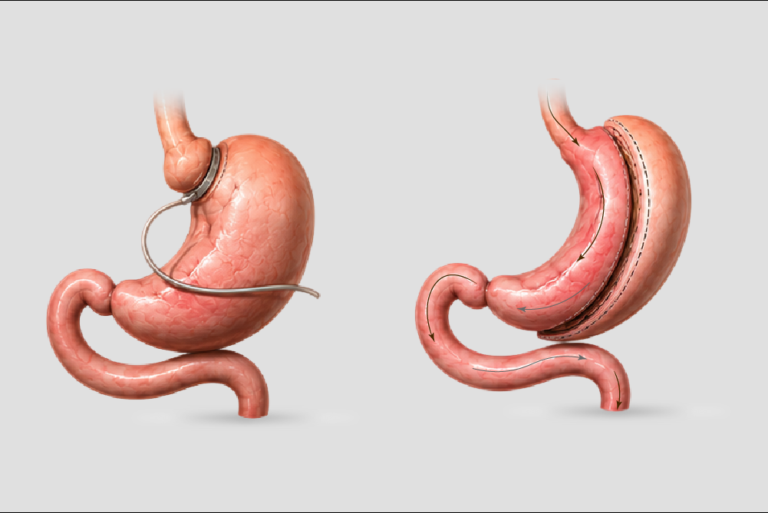
Adjustable gastric banding is different from most modern bariatric procedures because it does not require removal of stomach tissue or bypassing the intestine.
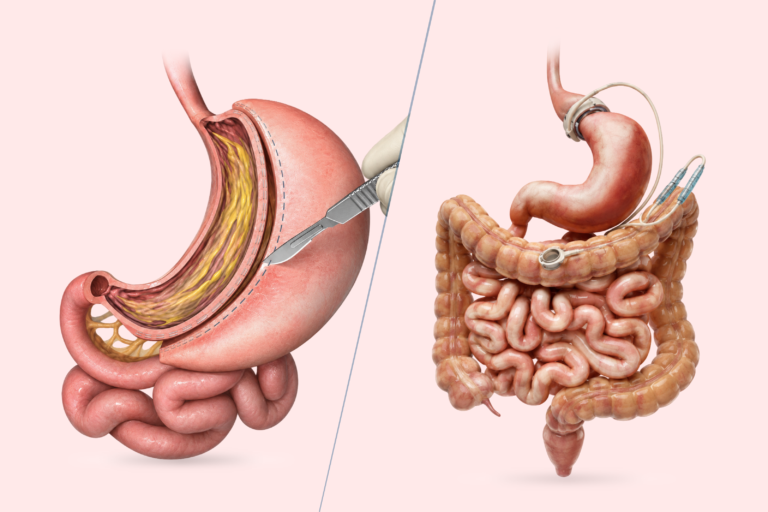
A silicone band is placed around the upper part of the stomach, creating a small pouch above the band. The size of the opening can be adjusted through a port placed beneath the skin, allowing restriction to be modified according to the patient’s response.1
The band can also be removed if needed, making adjustable gastric banding a removable surgical approach.1
Irreversible or Difficult-to-Reverse Procedures
Sleeve gastrectomy involves removing approximately 80% of the stomach and reshaping the remaining stomach into a narrow tube. Because a substantial portion of the stomach is removed, the procedure is considered non-reversible.1
Roux-en-Y gastric bypass involves creating a small stomach pouch and connecting it to a portion of the small intestine, thereby changing the normal route through which food travels. This represents a substantial anatomical alteration and is considerably more difficult to reverse than gastric banding.1
BPD/DS and SADI-S involve modification of the stomach along with rerouting of the small intestine. These procedures reduce nutrient absorption to varying degrees and can produce substantial metabolic effects. Because of their greater impact on nutrient absorption, long-term nutritional supplementation and monitoring are essential.1,3
Reversible vs. Irreversible: At a Glance
| Feature | Adjustable gastric banding | Sleeve gastrectomy | Gastric bypass |
| Stomach tissue removed | No | Approximately 80% | No, but stomach is divided |
| Intestine bypassed | No | No | Yes |
| Adjustable | Yes | No | No |
| Device removable | Yes | Not applicable | Not applicable |
| Anatomical reversal | Removable | Not reversible | Difficult |
| Nutritional impact | Lower risk of deficiencies | Requires nutritional monitoring | Greater need for nutritional monitoring |

What Are the Advantages and Disadvantages?
The differences between these procedures also lead to distinct benefits and trade-offs. The choice is therefore not simply about whether a procedure is reversible, but about what the patient may gain and what they may need to manage over the long term.
Adjustable and Removable Procedures
Potential advantages 1,3
- Adjustable treatment: The degree of restriction can be modified according to the patient’s response.
- Removability: The procedure does not commit the patient to permanent anatomical changes.
- Lower nutritional burden: Because the intestine is not bypassed, the risk of nutritional deficiencies is generally lower than with procedures involving intestinal bypass.
Potential limitations 1,4
- Less weight loss: Adjustable gastric banding generally produces slower and less weight loss than sleeve gastrectomy or gastric bypass.
- Ongoing follow-up: Regular adjustments and monitoring are required.
- Band-related complications: Slippage, erosion, swallowing difficulties, and the need for additional procedures can occur.
Permanent or Difficult-to-Reverse Procedures
Potential advantages
- Greater weight-loss potential: Sleeve gastrectomy and gastric bypass generally provide greater weight loss than adjustable gastric banding.1,3
- Metabolic benefits: These procedures can produce substantial improvements in obesity-related conditions.1
Potential limitations
- Permanent anatomical changes: Sleeve gastrectomy involves removal of a substantial portion of the stomach, while gastric bypass changes both the stomach and intestinal pathway.1
- Greater nutritional considerations: Procedures involving intestinal bypass may increase the risk of nutritional deficiencies and require long-term supplementation and monitoring.1,3
- Limited reversibility: Once the anatomy has been surgically altered, returning it to its original state may not be possible or may require complex surgery.
The Trade-off
Adjustability and anatomical flexibility may be important advantages for some patients, while greater weight-loss and metabolic potential may be more important for others.
The choice of procedure should be individualized based on the patient’s degree of obesity, obesity-related conditions, and overall clinical circumstances.2
Where Does Lap-Band® Fit In?
The FDA-approved LAP-BAND® Adjustable Gastric Banding System is indicated for weight reduction in severely obese adult patients with a BMI of at least 40 kg/m², or a BMI of at least 35 kg/m² with one or more severe comorbid conditions.5
Characteristics of the system 1,5
- No stomach removal: Weight loss is achieved without removing any part of the stomach.
- No intestinal bypass: The normal intestinal pathway is maintained.
- Adjustable restriction: The band’s level of restriction can be modified through the implanted access port.
- Tailored treatment: Adjustments allow the treatment to be adapted over time according to the patient’s response.
- For patients who value the possibility of modifying or removing the device, these characteristics can be clinically relevant.
What Makes Lap-Band® Different?
- Adjustability: The degree of restriction can be changed as the patient’s needs and response evolve.1
- Removability: Unlike procedures in which stomach tissue is permanently removed, the band can be removed when clinically indicated.1,5
- No stomach resection: The stomach remains intact rather than being surgically reduced through tissue removal.1
- No intestinal bypass: Food continues through the normal intestinal pathway, without bypassing portions of the small intestine as occurs with procedures such as BPD/DS.1,3
- Lower nutritional impact: ASMBS identifies adjustable gastric banding as having the lowest risk of vitamin and mineral deficiencies among the bariatric procedures it describes.1
But these advantages should not be considered in isolation.
Long-term evidence shows that adjustable gastric banding generally produces less weight loss than gastric bypass, and band-related complications may require additional procedures. A 15-year prospective study reported continued weight loss after adjustable gastric banding but also documented band erosions, port-related problems, slippage, intolerance, and band removals during long-term follow-up.4
This is why reversibility should be viewed as a potential advantage rather than as evidence that the procedure is universally superior.
Who May Benefit From a Reversible Approach?
Metabolic and bariatric surgery is not a one-size-fits-all treatment. Current ASMBS/IFSO guidelines recommend considering surgery according to BMI, metabolic disease, and the individual’s clinical circumstances rather than relying solely on older thresholds.2
Within that broader decision, the type of surgery should also reflect the patient’s expected weight-loss needs, medical conditions, willingness to undergo permanent anatomical changes, and ability to participate in long-term follow-up.2,3
For some patients, a procedure with greater weight-loss and metabolic effects may be the appropriate choice. For others, the possibility of adjustment and removal without gastric resection or intestinal bypass may be an important part of the discussion.
The Bottom Line
Reversible and irreversible weight-loss surgeries represent different approaches to the same clinical goal.
Permanent procedures such as sleeve gastrectomy and gastric bypass can provide greater weight loss and substantial metabolic benefits, but they permanently alter gastrointestinal anatomy. Adjustable gastric banding offers a different approach: the stomach and intestinal pathway are preserved, restriction can be adjusted, and the band can be removed when clinically necessary.1,3
For an appropriately selected patient, the value of a reversible procedure may therefore lie not in being “better” than permanent surgery, but in offering another evidence-based option when anatomical flexibility is an important consideration.
Learn how reversible and irreversible weight-loss surgeries differ and find the approach that best fits your health goals.
References
- American Society for Metabolic and Bariatric Surgery. Bariatric surgery procedures [Internet]. Newberry (FL): American Society for Metabolic and Bariatric Surgery; 2021 [cited 2026 Aug 10]. Available from: https://asmbs.org/patients/bariatric-surgery-procedures/
- Eisenberg, D., Shikora, S. A., Aarts, E., et al. (2023). 2022 American Society of Metabolic and Bariatric Surgery (ASMBS) and International Federation for the Surgery of Obesity and Metabolic Disorders (IFSO) Indications for Metabolic and Bariatric Surgery. Obesity surgery, 33(1), 3–14. https://doi.org/10.1007/s11695-022-06332-1
- Aderinto, N., Olatunji, G., Kokori, E., Olaniyi, P., Isarinade, T., & Yusuf, I. A. (2023). Recent advances in bariatric surgery: a narrative review of weight loss procedures. Annals of medicine and surgery (2012), 85(12), 6091–6104. https://doi.org/10.1097/MS9.0000000000001472
- Juodeikis, Ž., & Brimas, G. (2024). Long‑term outcomes of adjustable gastric banding: a 15‑year prospective randomized trial comparing 2 band types in 103 patients. Wideochirurgia i inne techniki maloinwazyjne = Videosurgery and other miniinvasive techniques, 19(3), 421–426. https://doi.org/10.20452/wiitm.2024.17918
- U.S. Food and Drug Administration. (2011). LAP-BAND adjustable gastric banding system: Premarket approval P000008, supplement S017. U.S. Department of Health and Human Services. Available from: https://www.accessdata.fda.gov/scripts/cdrh/cfdocs/cfpma/pma.cfm?id=P000008S017
- Jan, J. C., Hong, D., Bardaro, S. J., July, L. V., & Patterson, E. J. (2007). Comparative study between laparoscopic adjustable gastric banding and laparoscopic gastric bypass: single-institution, 5-year experience in bariatric surgery. Surgery for obesity and related diseases: Official journal of the American Society for Bariatric Surgery, 3(1), 42–51. https://doi.org/10.1016/j.soard.2006.11.005