
This guide explains Lap-Band® safety, risks, complications, side effects, warnings and long-term outcomes to help you make an informed decision about weight loss surgery.
What Is the Lap-Band System and How Does It Work?
Lap-Band is a minimally invasive solution to severe obesity. It is a totally reversible solution, which does not alter the anatomy. It works on the restrictive principle.
Lubomyr Kuzmak is considered a pioneer in bariatric surgery and the inventor of the adjustable gastric banding. In 2001, the US FDA approved the clinical application of the Lap-Band system for the treatment of morbid obesity.
Lab-Band System: Lap-Band System works on the principles of restriction, satiety, and the Green Zone.
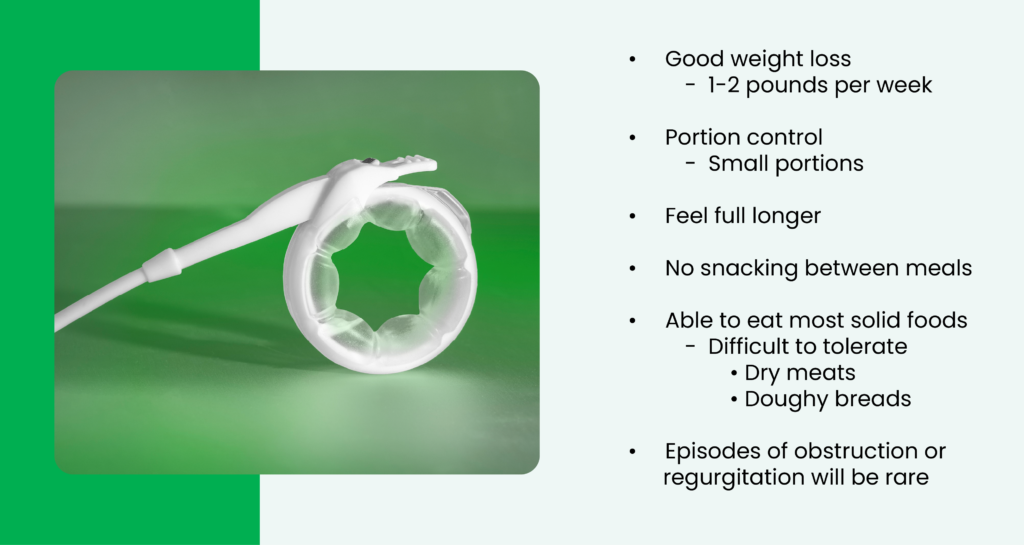
- Restriction – the gastric band is implanted like a ring around the upper stomach, creating a small pouch of around 15–30ml. The bottle neck created by the band fills the small pouch quickly and slows the passage of food bolus into the lower abdomen.
- Satiety – Feeling of fullness is created because the small pouch quickly fills with small amount of food. This food is slowly passed to the lower abdomen, delaying the overall digestion process. This reduces the overall food intake, resulting in weight loss.
- Green Zone – flexible silicon pouches in the Lap-Band are adjustable. Saline is used to inflate these pouches that can be adjusted according to your needs. This adjustment of the fill volume is done though an access port which is connected to the Lap-Band and placed subcutaneously in the abdomen.
Who is Eligible for Lap-Band Surgery?
A Lap-Band is recommended as a weight loss solution after conventional methods like diet, exercise and changes in lifestyle don’t bear the desired results. Asides, patient selection is done based on doctors evaluating on:
- The patient has a BMI >30 with one or more obesity related comorbidities
- The patient has a BMI of >40 without any other comorbidity
- Age of 18 or above
- Mentally stable
- Committed to long-term follow-ups and strict diet and lifestyle changes.
- Learn more about BMI requirements and candidacy criteria on our Lap-Band Eligibility page. https://www.lapband.com/start-your-journey/
Who Should Not Get Lap-Band Surgery?
Contraindications
A Lap-Band is not recommended as a weight loss solution for patients who have conditions which make them poor surgical candidates:
- Patients with inflammatory diseases of the gastrointestinal tract
- Patients with severe cardiopulmonary diseases or other serious organic diseases.
- Patients with potential upper gastrointestinal bleeding conditions such as esophageal or gastric varices.
- Patients with portal hypertension.
- Patients with congenital or acquired anomalies of the GI tract such as atresias or stenoses.
- Patients who have/experience an intra-operative gastric injury during the implantation procedure, such as a gastric perforation at or near the location of the intended band placement.
- Patients with cirrhosis.
- Patients with chronic pancreatitis.
- Patients who are addicted to alcohol and/or drugs.
- Non-adult patients (patients under 18 years of age).
- Patients who have an infection anywhere in their body or where the possibility of contamination prior to or during the surgery exists.
- Patients on chronic, long-term steroid treatment.
- Patients who are unable or unwilling to comply with dietary restrictions that are required by this procedure.
- Patients who are known to have, or suspected to have, an allergic reaction to materials contained in the system or who have exhibited pain intolerance to implanted devices.
- Patients or family members with a known diagnosis or pre-existing symptoms of autoimmune connective-tissue disease such as systemic lupus erythematosus or scleroderma.
- Pregnancy: patients who currently are or maybe pregnant. Patients who become pregnant after band placement may require deflation of their bands.
Important Lap-Band Safety Warnings Patients Must Know
- Lap-Band implant is just the 1st part of a patient’s weight loss journey. Desired weight loss targets require long-term commitment from the patient.
- Post Lap-Band implantation, patient has to bring major changes in lifestyle and eating habits, Long-term periodic follow-ups with the doctor, to undergo adjustments in the band (inflation/deflation). Only patients committed to this long-term commitment should choose Lab-Band as an obesity solution.
- Laparoscopic or laparotomic placement of the Lap-Band AP® System is major surgery and death can occur.
- Patients’ emotional and psychological stability should be evaluated prior to surgery. Gastric banding may be determined by a physician to be inappropriate for select patients.
- Patients should be advised that the Lap-Band AP® System is a long-term implant. Explant (removal) and replacement surgery may be indicated at any time. Medical management of adverse reactions may include explantation. Revision surgery for explantation and replacement may also be indicated to achieve patient satisfaction.
- Patients who become pregnant, severely ill, or who require more extensive nutrition may require deflation of their bands.
- To know more about Lap-Band related warnings visit: Lap-Band ® Important Safety Information
Lap-Band Risks and Complications: Common and Serious Side Effects
- Lap-Band implantation is a minimally invasive procedure. However, it is a major surgery and complications such as gastric strangulation, ischaemia, perforation, or volvulus. These are surgical emergencies requiring immediate operation.
- During the post-operative phase a patient may face challenges like; Nocturnal reflux, regurgitation, persistent cough, and increased intolerance of food and vomiting
- There may be complications like band slippage or migration from the original implant site, which requires emergency explant (removal) and replacement surgery at such times.
- To know more about Lap-Band related warnings visit: Lap-Band ® Important Safety Information
- Contact your Lap-Band Surgeon if you experience any of the above.
Long-Term Lap-Band Safety and Side Effects and Safety Considerations
- Lap-Band is a system designed to induce weight loss by limiting the food intake. The gastric band is implanted like a ring around the upper stomach, creating a small pouch of around 15–30ml. The bottle neck created by the band fills the small pouch quickly and slows the passage of food bolus into the lower abdomen, hence creating satiety – Feeling of fullness is created because the small pouch quickly fills with small amount of food. This food is slowly passed to the lower abdomen, delaying the overall digestion process. This reduces the overall food intake, resulting in weight loss.
- There are flexible silicon pouches in the Lap-Band which are filled with saline and the volume of saline is adjusted through an access port implanted subcutaneously near the navel. Post-op phase a patient has to visit the doctor for adjusting the fill volume of saline in the band. In cases like difficulty in swallowing, or vomiting, the band may require deflation. Similarly, not losing enough eight may require inflating the band by adding Saline. These adjustments are required frequently post-surgery.
- Long-term adverse reactions may include band erosion, saline leakage from the pouch.
- You can also explore patient experiences and expectations on our Life with Lap-Band page: Lap-Band ® Important Safety Information
Lap-Band Clinical Study Results
To read about Clinical Study Results visit: Lap-Band® Important Safety Information
Lap-Band device Safety Summary
- Lap-Band is implanted through a minimally invasive procedure. However, it is a major surgery and variables of adverse event are always there. The surgeon doing Lap-Band implant should be trained and have experienced support staff to ensure proper technique is used during the procedure.
- Symptoms such as gastric strangulation, ischaemia, perforation, or volvulus may occur due to improper site selection or over-tightening of the band.
- During the post-op phase a patient may face challenges like; nocturnal reflux, regurgitation, persistent cough, and increased intolerance of food and vomiting, which requires regular follow-up.
- To know more about device safety visit: Lap-Band® Important Safety Information
How Lap-Band Surgery Works: Procedure and Safety Overview
- After evaluating the patient’s suitability for the Lap-Band surgery, the doctor’s team ensures that patient understands and agrees to the need of major lifestyle changes, including eating habits, exercise routine and regular consultations for adjustments and progression checks. Only after informed consent is acquired, patient is taken for preoperative diagnostic evaluations, referred to as ‘surgical profile’. To rule out complications during or after the surgery. After reviewing surgical profile results the operating surgeon and anaesthesiologist clear the patient for surgery.
- The surgery is performed laparoscopically and takes approximately 1 to 2 hours. The patient is placed in a supine position and after anaesthesia is administered, surgeon reached the implant site through a minimally invasive procedure called “Pars Flaccida Dissection”. Once the implant is prepared, the Lap-Band is placed around the upper abdomen and neck of the oesophagus. Connecting tubes and the access port are connected and placed beneath the skin to allow saline adjustments, to inflate or deflate the adjustable pouches in the band.
- Read our detailed guide on the Lap-Band Procedure to understand each stage of surgery and recovery.
Bariatric Surgery Eligibility and Patient Safety Considerations
- Bariatric Surgery is recommended as a weight loss solution after conventional methods like diet, exercise and changes in lifestyle don’t bear the desired results. Patient selection is done based on doctors evaluating on:
- The patient has a BMI >30 with one or more obesity related comorbidities
- The patient has a BMI of >40 without any other comorbidity
- Age of 18 or above
- Mentally stable
- Committed to long-term follow-ups and strict diet and lifestyle changes.
Post Operative Diet Guidelines for Safe Recovery
- Dietary Progression and Post Op Adjustments:
- Stage 1 – of post-operative diet starts with liquid diet, patient must demonstrate tolerance before discharge
- Stage 2 – Soft and pureed food, progression will depend on tolerance of clear liquid diet over the 1st week.
- Stage 3 – Solid foods: introduced gradually; patient taught to eat slowly, chew thoroughly, small portions
- Unless there is a major complication the first band assessment/adjustment is done in 4–6 weeks post-surgery
- Post Op Eating and Diet changes: LAP-BAND works as a potion restrictor, leading to early satiation and slower digestion, hence food choice is very critical to prevent nutrition deficiency. Hence regular screening for Iron, folate, vitamins D & B12 and calcium is required. Patient must learn to eat slowly and chew each morsel thoroughly.
- Any persistent nausea, vomiting, or intolerance to foods should be reviewed by the doctor immediately.
- To know more about life after Lap-Band surgery visit: https://www.lapband.com/life-with-LAP-BAND/
Is Lap-Band Safe Long-Term?
- Yes, Lap-Band is a safe option for weight loss in cases of morbid obesity. It works on restrictive principle. It is totally reversible and does not alter human anatomy. However, patients must be committed to long-term engagement with the doctor as the Lap-Band requires timely adjustments. Along with major changes in lifestyle and diet.
What Are The Most Common Lap-Band Complications?
- Post operative complications: Most patients are discharged within 1 or 2 days following the Lap-Band surgery. If the case did not have complications, normal daily activities can be started within 1 or 2 weeks after the surgery. Like all surgical wounds, the incision sites should be kept clean and monitored for signs of any infection.
- persistent nausea, vomiting, or intolerance to food may be there and should be reviewed by the doctor immediately.
- There may be complications related to the placement and tightening of the band causing Symptoms like gastric strangulation, ischaemia, perforation, or volvulus.
Can Lap-Band be removed?
- Yes, Lab-Band can be removed. It would require a minimally invasive surgery and 1 or 2 days of post-operative recovery time. Decision to remove a Lab-band is taken in consultation with the surgeon and depends on factors such as:
- Persistent intolerance to the band, including ongoing nausea, vomiting, or difficulty swallowing.
- Band slippage, migration, or other device-related complications.
- Inadequate weight loss or significant weight regain despite appropriate adjustments and lifestyle modifications.
- Development of gastric pouch enlargement, esophageal dilation, or reflux symptoms that do not improve with band adjustments.
- Patient preference, lifestyle considerations, or the need to transition to another bariatric procedure.
- Following band removal, the surgeon will discuss suitable options for ongoing weight management based on the patient’s health status and goals.
Is Lap-Band still used today?
- Yes Lap-Band is one of the choices for weight loss in cases of severe obesity. It holds advantage over other interventions, as it is minimally invasive, totally reversible, without altering the anatomy.
- Lap-Band 2.0 FLEX is the latest advancement in laparoscopic adjustable gastric banding. It contains two Compliant Tubing Reservoirs that are designed to modulate intraband pressure to accommodate the passage of larger food bolus, while maintaining a constant state of restriction.
- The Compliant Tubing acts as a reservoir within the Lap-Band 2.0 System. It can expand to hold extra saline out of the band component, allowing the band stoma to temporarily dilate and facilitate the passage of a food bolus through the band. This temporary self-adjustment may reduce the potential for food obstructions and relieve the high intraluminal gastric pressure that is often associated with discomfort, regurgitation, or vomiting. After the bolus passes, the slightly expanded reservoir will then contract back to its steady original state and push the saline back in the band tubing.
- Another feature of the Lap-Band 2.0 FLEX System is that it is also designed to enable the re-opening of the band in the case of slippage or malposition.